In this article, I reflect on my performance art practice between 2003 and 2010, tracing the evolution of my multidisciplinary approach that combines text, digitally manipulated sound, and video projection. Through a detailed analysis of key works such as The Mother of Harlots, Hyaena, Litany, and The Emerald City, I explore my long-term fascination with borderline states of mind and the experience of social and psychological isolation. I describe the transition from more traditional theatrical settings toward minimalist, technologically driven performances focused on vocal manipulation and real-time sound processing. My goal is to define the essence of these “events,” which confront the audience with institutional critique, the myth of the family, and the profound vulnerability of individuals existing on the fringes of society.
I developed and premiered my first performance in 2003 during a residency at the Headlands Center for the Arts in Sausalito, California. Titled The Mother of Harlots, the work explores how the majority’s tendency to overlook the needs of specific minorities leads to profound isolation and, ultimately, death. The performance integrated recitations of exclusionary passages from the Old Testament and the Revelation of St. John, alongside my own texts inspired by St. Augustine’s Confessions. I utilized sound effects to evoke the acoustic atmosphere of a cathedral, complemented by ritualistic costumes, theatrical blood, and video projections.
During the performance, I transitioned between two symbolic costumes: a “preacher” figure evoking Moses and the weight of the Old Testament, and a woman in red from the Book of Revelation. Following the Latin consecration from the Catholic Mass (“nunc praesentia dabo corpus et sanguinem”), I tore away a white robe to reveal a red dress, covering my face in blood. This was mirrored by a video projection of a red-clad figure standing on a seashore with their back to the audience. The work served as a provocative call to reconsider the Church’s role in modern society, concluding with a plea for compassion and a deeper understanding of human difference.
My objective was to immerse the viewer in an environment defined by intense visual stimuli and digitally manipulated sound, compelling a more visceral engagement with the recited texts. I sought to evoke the internal state of an isolated mind—a principle echoed in Antonin Artaud’s “Theatre of Cruelty” from the 1930s. While Artaud’s influence was later expanded upon by groups like The Living Theatre, whose provocative actions often led to physical confrontations and police intervention, deriving a direct lineage from Artaud remains complex. His theoretical writings often function more as lyrical prose than precise definitions, though this ambiguity does not diminish their profound impact on my work.
Over time, The Mother of Harlots evolved alongside my understanding of the medium. In 2004, I refined the structure and collaborated with Dušan Kopčov on a musical score, presenting this version at the Elbefest festival in Bratislava’s Zero Space A4. As I began mastering digital sound myself, the performance underwent further radical shifts, reaching its final form at the Intermedia festival in Banská Bystrica in 2009. In this iteration, I focused exclusively on excerpts from the Revelation of St. John, using real-time sound manipulation devices that I controlled directly during the performance.
Parallel to this, I developed Hyaena (premiered in 2005). While The Mother of Harlots remained somewhat “theatrical”—with its emphasis on stage production, candles, and a traditional pulpit—Hyaena leaned more heavily into video and pre-recorded digital soundscapes, making vocal experimentation essential. I utilized the full range of my voice, blurring the line between speech and song through specific melodic structures. By using two microphones—one with a subtle delay and the other with varying digital modulations—and a quadraphonic sound system, I “trapped” the audience within a multi-layered, immersive sonic environment.
In Hyaena, the theme of isolation expands. I no longer performed as the “preacher” or the “punishing hand of the law,” but as the isolated individual themselves. The text functions as a stream of consciousness, capturing the paranoia and delusions of persecution that arise from long-term solitude. The performance also incorporated the poetry of Rainer Maria Rilke (from The Notebooks of Malte Laurids Brigge) and Henri Michaux. Visually, I employed stroboscopic editing and the motif of blood as a vital symbol. Hyaena was frequently paired with Litany, a performance dealing with involuntary death, incorporating texts from Isaiah, Job, and Francis Jammes.
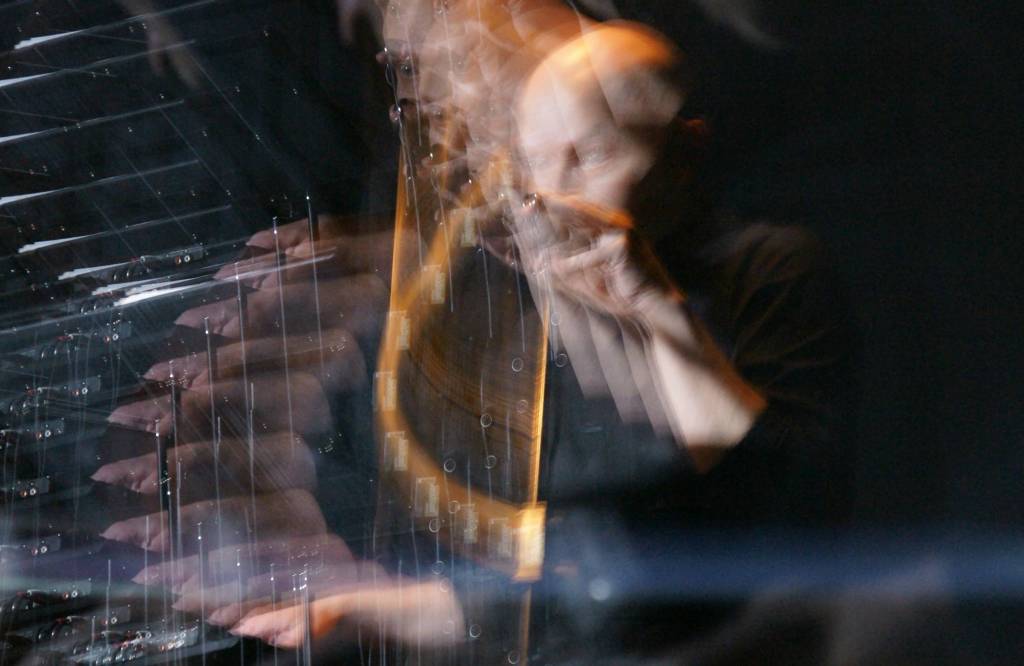
My most recent work, The Emerald City, centers on my own texts inspired by Artaud, interwoven with dialogues from L. Frank Baum’s The Wizard of Oz and Ken Kesey’s One Flew Over the Cuckoo’s Nest. In this piece, I push the boundaries of articulated speech. Words are often delivered on the edge of intelligibility, interspersed with raw, unarticulated sounds that give vent to simulated emotion. This creates a “universal language” that resonates with the viewer’s own subconscious experience. I moved away from pre-recorded audio in favor of real-time vocal processing and live looping, multiplying the sonic presence of the suffering body.
The use of video also shifted in The Emerald City. I employed dual projections: one featuring the Moon as a symbol of loneliness, and another composed of short loops focusing on corporeality. By removing the synchronized audio tracks used in Hyaena, I gained greater performative freedom to interact with the sound processor. A pivotal element of the work is the spiritual Swing Low, Sweet Chariot, which introduces a note of hope for a better future.
As an artist, I am primarily interested in borderline states of mind where the self is redefined through the experience of isolation and sensory deprivation. My texts are internal monologues—visions and fears of possible events—supplemented by the rambling voices of Baum’s and Kesey’s characters. My goal is not to tell a linear story, but to create an “event” where the viewer becomes an immediate witness to a psychological state, regardless of who the character is or why they are confined.
I am currently developing a new performance that incorporates other performers for the first time. It is inspired by the story of Bobby Griffith (from Leroy Aarons’ Prayers for Bobby). The Griffiths represent a middle-class American family unable to reconcile their faith with their son’s sexuality, indirectly leading to his suicide. The heart of the work is the relationship between a devoutly Presbyterian mother and her son, who experiences isolation within his own family. Bobby’s tragic end serves as a catalyst for a critique of institutional totality. Beyond examining the Church’s passive stance toward social issues, I aim to deconstruct the “myth of the family” and its frequent failure to protect and support its own members.
Maroš Rovňák, 2010 (with translations of selected parts by Frances Bathgate), revised in 2026

