Who Was Peter Hujar?
Reflections on Peter Hujar’s Portraits in Life and Death at the Venice Biennale 2024
By Maroš Rovňák
The Slovak version of this essay was published in Fraktál 1/2025.
Abstract
This personal narrative and critical reflection explores the artistic legacy and enduring resonance of American photographer Peter Hujar through the lens of a personal encounter with his exhibition Portraits in Life and Death, presented as a collateral event of the 60th Venice Biennale at the Istituto Santa Maria della Pietà. Interweaving private grief, memory, and geographic displacement following the loss of the author’s mother, the essay examines Hujar’s quiet, unvarnished portraiture of New York’s 1970s downtown LGBTQIA+ subculture alongside his 1963 series of mummified remains in the Capuchin catacombs of Palermo. By critically re-evaluating Susan Sontag’s original 1976 introductory essay, the text situates Hujar’s practice within the socio-political struggles of queer liberation, the devastating impact of the 1980s AIDS crisis, and his historic marginalization relative to contemporaries such as Diane Arbus and Robert Mapplethorpe. Ultimately, the essay frames Hujar’s intimate medium as a sacred, melancholic space of presence and transience, bridged by dialogue with contemporary installation art and literary epitaphs.
Keywords: Peter Hujar, Portraits in Life and Death, Venice Biennale, photography, Downtown New York subculture, Capuchin Catacombs, Susan Sontag, AIDS crisis, queer identity, memory.
“I want people to speak about me in quiet tones.
When people speak of me, I want them to whisper.”
— Peter Hujar
This personal narrative and critical reflection explores the artistic legacy and enduring resonance of American photographer Peter Hujar through the lens of a personal encounter with his exhibition Portraits in Life and Death, presented as a collateral event of the 60th Venice Biennale at the Istituto Santa Maria della Pietà. Interweaving private grief, memory, and geographic displacement following the loss of the author’s mother, the essay examines Hujar’s quiet, unvarnished portraiture of New York’s 1970s downtown LGBTQIA+ subculture alongside his 1963 series of mummified remains in the Capuchin catacombs of Palermo. By critically re-evaluating Susan Sontag’s original 1976 introductory essay, the text situates Hujar’s practice within the socio-political struggles of queer liberation, the devastating impact of the 1980s
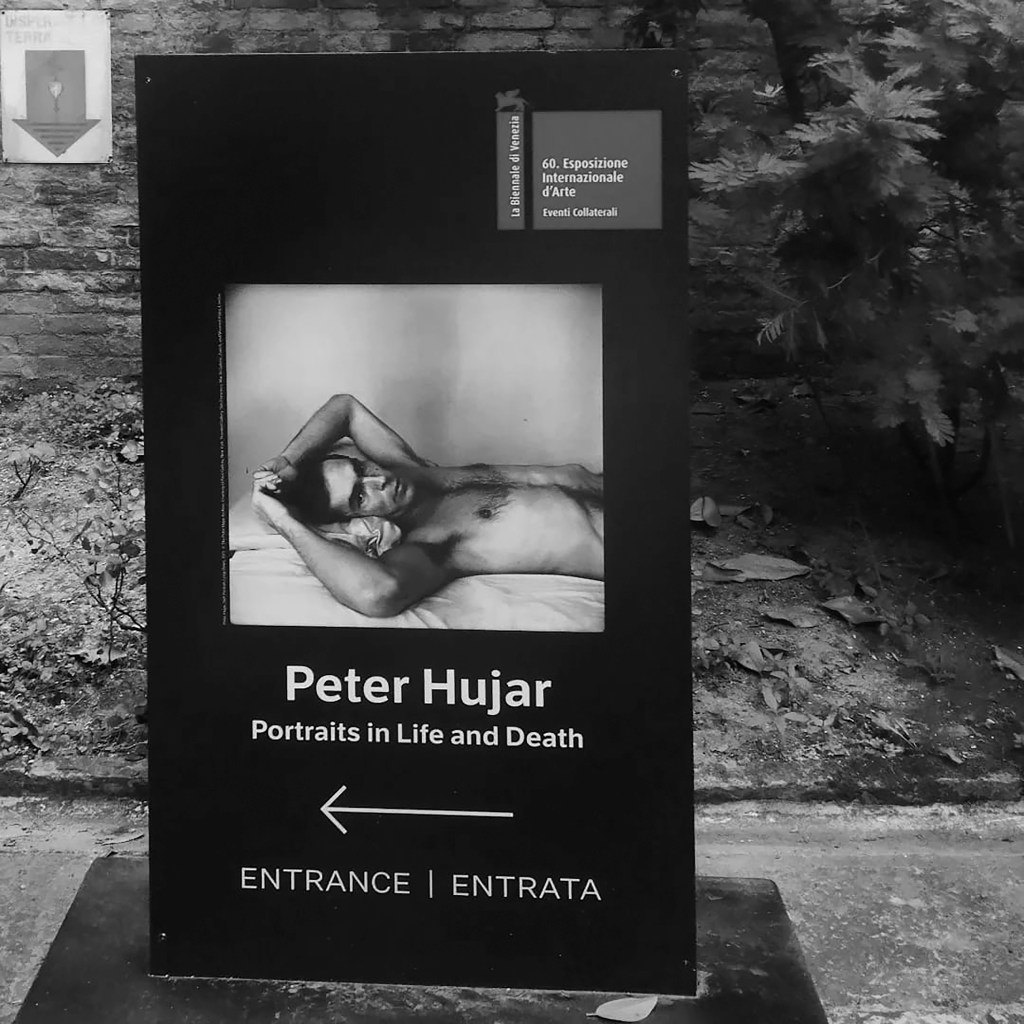
In August, in my parents’ half-empty apartment, I stumbled upon a series of photographs from their 1991 trip to Venice. This discovery briefly interrupted their loud absence in my life—it was less than four months after my mother’s funeral and just a week before what would have been her birthday—and at the same time, brought me right back to Venice. There, earlier that same month, I had visited Peter Hujar’s photography exhibition Portraits in Life and Death. Adriano Pedrosa, curator of the 60th Venice Biennale titled Stranieri Ovunque (Foreigners Everywhere), included Hujar’s intimate exhibition among the thirty collateral events of this major art survey. In a short curatorial text, Grace Deveney referenced Susan Sontag’s famous remark that photography turns the entire world into a graveyard.
I went to see the exhibition mainly at the suggestion of my partner. After two days of taking in art at the Arsenale and Giardini under the scorching August sun, I felt the need to shut out art for a while. However, it was hardly a great sacrifice: just two vaporetto stops from the Salute station, which was about a four-minute walk from our rented apartment.
The exhibition space was tucked away in an inconspicuous alley, Calle de la Pietà, leading off the Riva degli Schiavoni waterfront next to the church of Santa Maria della Pietà. Behind it sits the institute of the same name—one of the world’s oldest institutions dedicated to the care of abandoned children. The institute’s courtyard, featuring a patch of greenery that is a rarity in Venice today, felt like an oasis of silence amid a chaos of words, snatched fragments of sentences, shouts in various languages, and crowds pushing past in pursuit of selfie souvenirs against the backdrop of ornate architectural fragments near the neighboring Doge’s Palace from where we had just arrived.
The modest patio, shaded by the monumental sacral structure designed by Giorgio Massari and completed in 1906, unexpectedly offered a space for stillness. It was not quiet in the sense of being empty, but the pace at which people moved here was completely different from that outside. The courtyard was dominated by a monumental installation by Romanian artist Victoria Zidaru, to which I will return later.
At that time, I knew nothing about Peter Hujar and had no idea what to expect from his exhibition. In fact, this text is not about whether or how Hujar’s exhibition was exceptional, but rather that it became so for me.
Peter Hujar was born on October 11, 1934, in Trenton, New Jersey. His father, Joseph John, who made a living smuggling illicit goods, abandoned Peter’s mother, Rose Murphy, during her pregnancy and never met his son. Until 1946, when his mother brought him to live with her in New York, Peter was raised on a farm by his grandparents, who spoke only Ukrainian with him. Because of his poor English, his teachers thought he suffered from a learning disability. In 1950, he ran away from his mother—who worked as a waitress in Lower Manhattan—and her second husband, after experiencing violence and abuse at their hands.
By the age of sixteen, he was entirely on his own. He completed his high school education with a focus on photography at the School of Industrial Art in Manhattan. After graduating, he worked as a hired assistant to commercial photographers. There he mastered sophisticated photographic techniques, and after work, he was allowed to use his employers’ studios for his personal projects. In 1962, Hujar received a Fulbright grant to study filmmaking in Rome.
Upon returning to the U.S. in 1964, he became the chief assistant in Harold Krieger’s commercial photo studio, met Andy Warhol, and grew close to the “outsiders” from his Factory, including transgender actress Candy Darling and singer-actor Jackie Curtis. Hujar’s face, as well as that of his then-partner Paul Thek, appeared in Warhol’s film compilation The Thirteen Most Beautiful Boys (1964). In 1967, based on his submitted portfolio—a series of nudes in motion for which he posed himself—Hujar was selected as one of a group of young photographers for an intensive masterclass in fashion photography led by Richard Avedon and Marvin Israel, where he met Diane Arbus.
From the early 1970s, Hujar’s income came from fashion and advertising photography. He worked for Harper’s Bazaar and GQ, but assignment work did not fulfill him. He increasingly viewed photography as art and refused to see it merely as a commercial product made to order. From 1968 to 1971, he contributed to Newspaper, an underground pictorial queer magazine that doubled as a conceptual art object. B-movie sci-fi stills, ethnographic photography, and both gay and straight pornographic photos were presented alongside one another as equals to blur the lines between trade journals and entertainment media. Alongside Hujar, artists such as Paul Thek, Diane Arbus, Richard Avedon, Ray Johnson, Andy Warhol, Yayoi Kusama, and Peter Beard contributed to the publication.
Peter Hujar was openly gay and actively involved in the gay rights movement. In 1969, he took a photograph depicting a street protest of gay activists, which was published under the title Come Out! in the Gay Liberation Front newspaper. Around the same time, he created a series of close-up photos of a man’s face experiencing orgasm. In 1973, he moved into a loft apartment above the Eden Theatre in the East Village. By then, his attention was fully focused on the Downtown New York subculture surrounding trans people and drag performers in local queer clubs and cabarets who challenged accepted social norms.
With his camera—and often without it—he frequented the decaying piers on the west bank of the Hudson River, a popular cruising site for gay men seeking casual encounters. It was a dangerous area with high crime rates; perhaps for that very reason, it temporarily offered a marginalized community a sense of freedom, expressed through graffiti, happenings, and performances.
In 1981, Peter Hujar met David Wojnarowicz, who was twenty years his junior. Their relationship soon shifted from romantic to paternal and avuncular—a bond between mentor and protégé. In January 1987, Hujar was diagnosed with HIV. He never picked up a camera again and succumbed to AIDS-related pneumonia nine months later. David Wojnarowicz documented his frail body on the hospital bed with a 16mm camera and photographed his almost unrecognizable face, hands, and feet. Peter Hujar is buried at the Gate of Heaven Cemetery in Valhalla, New York.
During his lifetime, Peter Hujar failed to gain commercial or critical dominance in established art circles. Although he was not unknown within them, no major art institution showed serious interest in his work. He published only a single monograph, sharing its title and content with the Venice exhibition (Portraits in Life and Death, Da Capo Press, 1976), for which his long-time friend Susan Sontag wrote the introduction. The ideas she presented there later reappeared in one of her seminal essays on photography (On Photography, 1977).
The monograph, like the exhibition, consisted of twenty-nine portraits of Hujar’s contemporaries from the Lower East Side—figures from New York’s 1970s alternative artistic and intellectual scene, lovers, friends, acquaintances, or simply people moving within the photographer’s orbit—juxtaposed with twelve photographs of mummified bodies in the catacombs of the Capuchin monastery of Santa Maria della Pace in Palermo, Sicily, which Hujar had taken in 1963. And although the artist himself stated that the series did not necessarily need to be read as a contrast between life and death, their combination invites it, supported by Sontag’s quoted thoughts: “Photography shows death… More than that, it shows the sex appeal of death.”
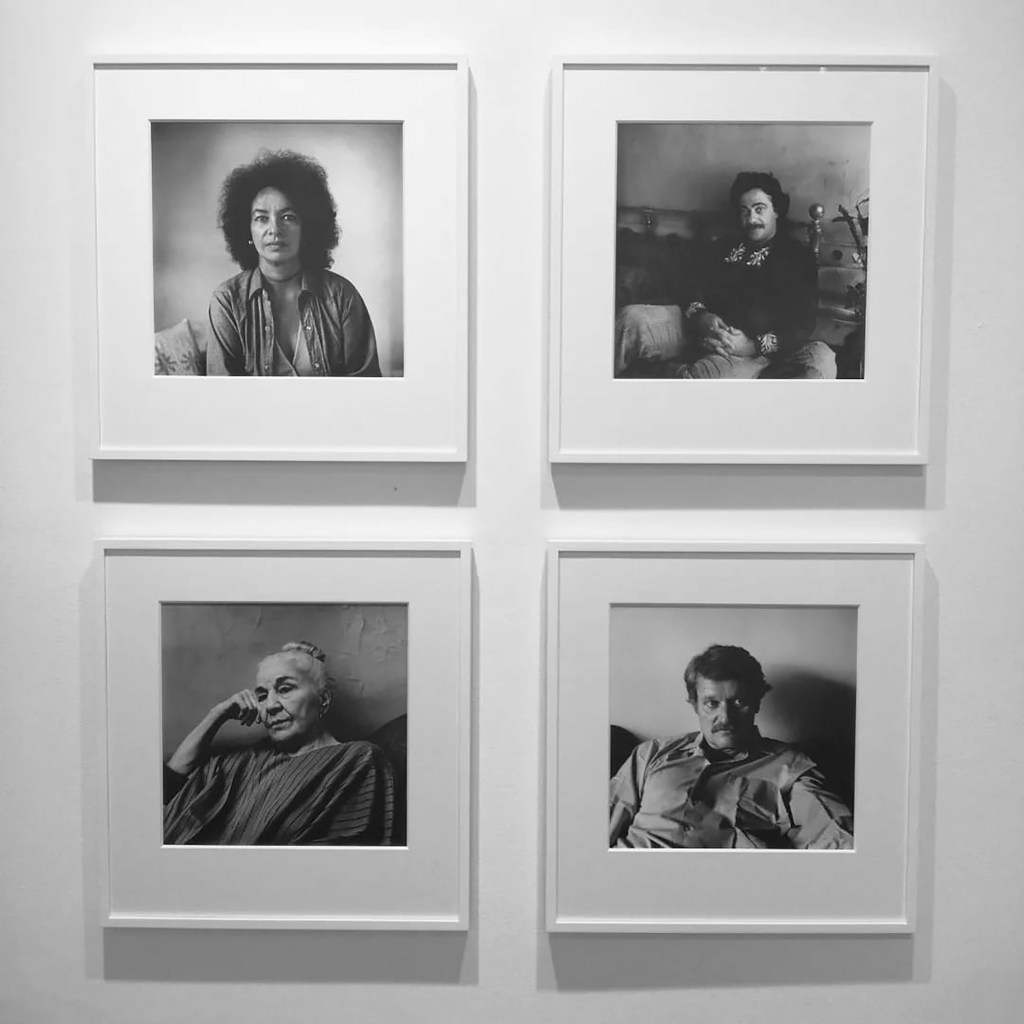
The exhibition of Hujar’s photographs felt modest. Forty-one photographs in white mats and white frames were arranged on the white walls of four rooms featuring checkerboard tile floors. The photographs of the mummified bodies in the Palermo catacombs were deeply evocative. Perhaps it was the powerlessness of the subjects, or their closed life stories about which I could only speculate (a child’s mummy with an anguished expression—Palermo Catacombs #6, 1963), their inviolability, the sacredness of death, or simply the precise interplay of light and shadow, combined with an intimate scale of prints that we have grown unaccustomed to in modern galleries. In contrast to the almost museum-like detachment of the preserved bodies, there seemed to be something alive, alluring, and engaging in every frame. Most of the mummified bodies are isolated in the shots, creating a sense of intimacy; only three photographs offer a broader view of the catacombs. One shows a pair of upright, slender children’s bodies pressed into a narrow horizontal niche between vertical niches containing what are likely other members of their family (Palermo Catacombs #7); another shows a monk standing vertically amidst rows of bodies stacked in horizontal niches (Palermo Catacombs #12); and finally, a section of a group of monks’ mummies arranged horizontally.
The practice of mummifying the deceased was particularly characteristic of the Capuchin monks who arrived in Palermo in 1534, nine years after the founding of their order. Initially, they buried their deceased brothers in the church of Santa Maria della Pace under the Altar of St. Anne. A later exhumation to free up space for more graves revealed naturally mummified bodies with intact faces. This natural process, resulting from the unique microclimate of the porous tufa soil, was declared a divine miracle, and the decision was made to display the bodies as relics. Over the years, they were joined by other monks and later by affluent citizens of the city. Exhibiting mummified family members in the Capuchin catacombs became a statement of a family’s social status. The display of exhumed bones and mummified bodies was a key element of the Counter-Reformation strategies through which the Catholic Church sought to reinforce communal faith and a collective awareness of mortality.
Peter Hujar visited the Palermo catacombs in 1963 during a trip with painter, sculptor, and installation art pioneer Paul Thek. The two men had met in 1957 in Florida and became lovers. Hujar also took a portrait of him in the catacombs (Paul Thek (II), 1963). The twenty-three-year-old artist poses against a backdrop of display cases and niches featuring preserved bodies resting horizontally or mounted vertically.
Instead of that photograph, Hujar chose to include a portrait of the artist taken twelve years later (Paul Thek (III), 1975) in his only monograph, a work that conceptually aligns with the rest of the series. Susan Sontag wrote of these portraits: “In the first part of this selection of Peter Hujar’s work, subjects stand, sit, slouch, mostly lie down—and seem to be meditating on their mortality. They meditate whether they—I—he (for the photographer belongs among his subjects) admit it or not.”
What struck me first about Hujar’s portraits was their raw quality. The photographer worked exclusively in black-and-white film, embellished nothing, and preferred natural light. He isolated his subjects in their immediate environments, preferring neutral backgrounds to focus undivided attention on them. Some subjects are nude or half-naked, others dressed; yet their clothing is never ostentatious, sometimes referencing the ethnic background they originated from or where they spent a significant part of their lives. For instance, in the portrait of William S. Burroughs (William S. Burroughs (II), 1975), an embroidered Arab vest is visible beneath his jacket—a nod to his time in Tangier, Morocco, where his novel Naked Lunch (1959) was written. Conversely, Harris Glenn Milstead—the star of John Waters’ cult films who performed as the drag queen Divine in exaggerated makeup and flamboyant, glittering gowns—is shown without a wig, wearing light makeup in a simple, light-colored jumpsuit (Divine, 1975). As for the nudity of Hujar’s models, it does not necessarily need to be viewed as eroticism; in his own words, a naked body is merely an extension of the portrait.
Contact sheets from Peter Hujar’s archive reveal that his work with a subject was long and focused. He was willing to spend hours with a person until he was convinced they were sufficiently relaxed and ready to be photographed. The Department of Drawings and Prints at The Morgan Library & Museum in New York currently holds nearly 5,800 of Hujar’s contact sheets. They show that the photographer rarely had a rigid pre-conceived idea of the final image. The contact sheets reveal full rolls of film dedicated to a single model with varying facial expressions—sitting, lying down, or even walking around the space where the photographer captured them. Thanks to this volume of material, he could select the frame in which his subject appeared most authentic. For example, the photo of Paul Thek captures him mid-thought, as if wrestling with an idea that had been on his mind for a long time. Meanwhile, Susan Sontag’s face (Susan Sontag, 1975) bears the hint of a subtle smile, even though Hujar photographed her on a hospital bed. One frame from this shoot captures her face lit up with a wide smile—taken at a time when she was battling stage IV breast cancer with a slim chance of survival. Sontag won her first fight against cancer, though she carried the physical consequences for the rest of her life. While her direct response to that ordeal was the book Illness as Metaphor (1978), perhaps it was also this experience that informed her reflections on photography as an ongoing reminder of life’s transience.
Upon closer examination of the photographs from Hujar’s Venice exhibition in the second edition of Portraits in Life and Death (Liveright Publishing Corporation, 2024)—which has since found a place in my library—as well as researching the facts of his life and career, I cannot help feeling that Susan Sontag’s introductory text reveals surprisingly little about Hujar’s actual oeuvre. Her essays on photography were published just a year after Hujar’s monograph, and although they mention his contemporaries, his name is not cited a single time. Stephen Koch, who currently directs the Peter Hujar Archive, noted that to her, he probably wasn’t famous enough.
The true significance of Hujar’s work lies in his depiction of the Downtown New York LGBTQIA+ community of the 1970s—a community that Fran Lebowitz, a friend of Hujar’s and one of the subjects featured in the exhibition, once remarked could fit inside a single coffee shop. It was a community of queer and trans individuals who had the courage to be themselves and proudly claim their rights. His photographs are about crossing or blurring gender boundaries, breaking taboos surrounding the human body, but also about the buildings and urban spaces that gentrification erased from the map of New York in the 1990s or transformed into expensive lofts.
Peter Hujar was not unknown to the art world during his lifetime, yet no art institution showed long-term interest in his oeuvre. He remained in the shadow of his colleagues—Diane Arbus, who was a decade older, and Robert Mapplethorpe, a decade younger—who explored similar themes but with starkly different approaches. Mapplethorpe considered Hujar a great photographer, yet at the thought of hanging Hujar’s photos on his wall, he merely smirked. It was an allusion to the heavy grain in Hujar’s prints, as seen in the portrait of Lola Pashalinski (Lola Pashalinski Backstage, “Camille,” 1974) preparing backstage, even though a vast portion of his work is characterized by exceptional clarity and delicate mid-tones.
Perhaps the marginalization of Hujar’s work can be better understood through an anecdote from Benjamin Moser’s introduction to the second edition of his monograph. Moser notes that two years after the first publication of Hujar’s book, a photograph of Bruce de Sainte Croix sitting naked in a chair holding an erect penis was included in an exhibition titled Male Nude. The photograph was not placed in the main exhibition gallery—visitors could view it only upon request—yet it still sparked a wave of outrage and resistance.
Hujar’s first major retrospective, presenting a selection of one hundred and fifty photographs, arrived in 1996 at the Stedelijk Museum in Amsterdam. Broader interest in his work within the United States did not come until the exhibition Night Vision: Photography After Dark at The Metropolitan Museum of Art in New York in 2011—nearly twenty-six years after his death.
Although I knew almost nothing about Peter Hujar at the time of the exhibition in Venice, faces such as William S. Burroughs, Divine, John Waters, and Susan Sontag were naturally familiar to me. Together with the other subjects, they represent a community that sought to carve out a place on the Off-off-Broadway stage, through emerging art forms, independent film, and experimental literature, while simultaneously demanding official recognition of their non-binary identities (with the possible exception of Susan Sontag, who kept her sexual identity secret throughout her life so as not to affect how her intellectual work was perceived).
Gay men who had been fighting for their rights since 1969 were forced to face a new wave of stigmatization just a decade later. Being gay in the 1980s no longer posed merely an ideological threat to majority values, but an immediate mortal threat. AIDS, which emerged in the early 1980s, was framed as a “gay disease.” Early in the research phase, medical authorities even considered naming it GRID—Gay-Related Immune Deficiency—which naturally led to even harsher discrimination. Many of the subjects in Hujar’s exhibition are no longer alive; four of them, including the photographer himself and his former lover Paul Thek, succumbed to AIDS. Hujar’s photographs revived this sad history for me. Their placement adjacent to sacred spaces lent the work a peculiar aura. I did not leave the gallery space as the same person who had entered.
The sculptural installation made of natural materials by Victoria Zidaru, titled Lingua Ignota, which graced the courtyard outside the gallery space and which I mentioned earlier, was inspired by the legacy of the medieval mystic Hildegard von Bingen. Lingua ignota translates from Latin as an unknown, mysterious, or incomprehensible language. While it was certainly not the intention of the artist or the organizers of either exhibition, and I would be reluctant to reduce her piece to a message unrelated to it, the artwork served as an apt commentary on Hujar’s status as an artist overlooked by his contemporaries. The Romanian artist’s monumental installation was complemented by numerous captivating small natural objects wrapped in cloth ties featuring handwritten inscriptions in Italian and Latin, offered to visitors in exchange for a few written words. Without much deliberation, I chose two objects. A short while later, I discovered that the words on one stated that warm, calm joy is victory, while the second proclaimed—emphasized with an exclamation point—that everything is canceled. In the artist’s guestbook, I wrote Rainer Maria Rilke’s epitaph from his gravestone in Raron, Switzerland:
Rose, oh reiner Widerspruch, Lust,
niemandes Schlaf zu sein unter soviel
Lidern.
Rose, oh pure contradiction, desire
to be no one’s sleep under so many
lids.
The second edition of Peter Hujar’s monograph Portraits in Life and Death, released nearly fifty years after the first and almost forty years after his passing, is now available on our market. The book is enriched with an introductory essay by American writer and translator Benjamin Moser, alongside brief profiles of the featured personalities.

