Item Reus, 2017, audiovisual installation, performance / Item reus, 2017 audiovizuálna inštalácia, performancia
Vizuálne pozadie k živej performancii so štúdiovou zvukovou linkou. © Maroš Rovňák 2017.
English version
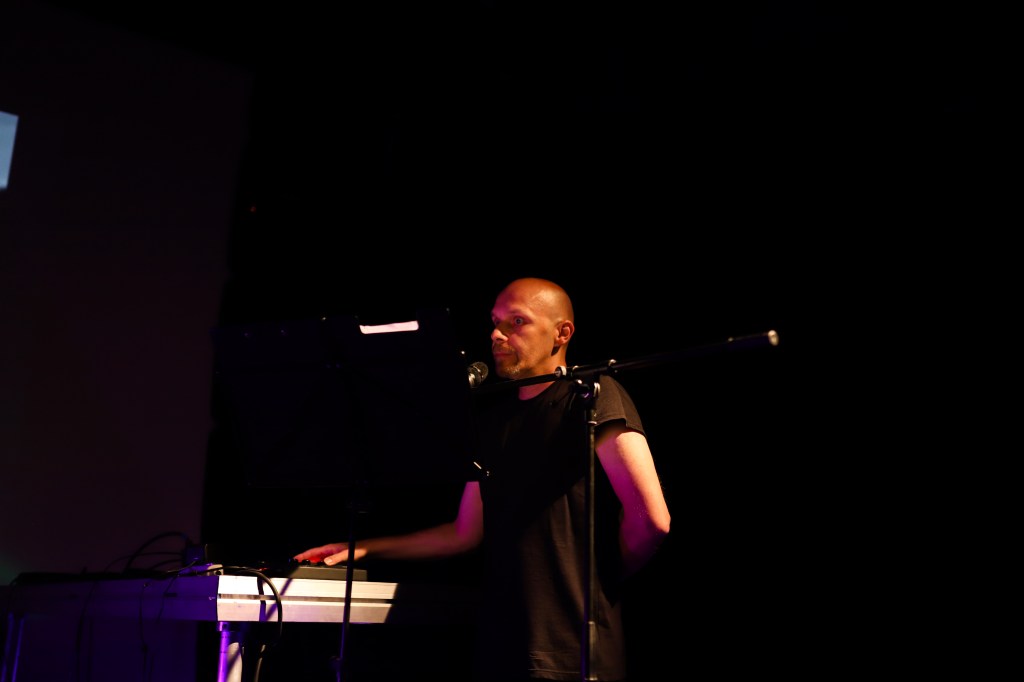
The impulse to create Item reus (Latin for also guilty) came from a passage in the novel Jo Confesso (2011) by Catalan author Jaume Cabré. In the story, the protagonist—in a state of mental dissolution—becomes unable to distinguish between the medieval inquisitions of the Catholic Church and the brutal methods of the Nazi Gestapo. The performance was presented as a work-in-progress at the LiKe festival in Košice in October 2017, and later premiered as a finished piece at the Krokus Gallery in Bratislava during the opening of the exhibition I Feel Weird Again (Model Reality II) in November 2017.
The auditory layer of the work is a multi-layered composition of digital soundscapes and choral textures created from my own voice. During the recitation, the voice is digitally manipulated in real-time through pitch-shifting and delays. The visual component (backdrop video) features a reclining male body shrouded in smoke from industrial chimneys, a direct reference to the Nazi extermination camps of World War II. Simultaneously, the imagery evokes the body as a sacred relic, corpus christi, and the ritual of the Eucharist.
The title points to the collective complicity of those whose silence legitimizes the suppression of freedom. By confronting the history of the Church with the totalitarian regimes of the 20th century, the work highlights the universal nature of repression. This critique of institutional violence—a long-standing element of my artistic practice—serves as a stark warning against contemporary populism and political chaos.
Translation of the recited text
In ancient times, when great travelers at the edge of the world encountered a vast water or a great wall, an angel appeared to a holy man, commanding him to dedicate his life to our Lord God. The Catalan scholar Nicolau Eimeric soon became a prudent professor of theology, and his endless devotion to the Catholic faith inspired him to lead the Inquisition against the filth of unworthy heretics in all the kingdoms of Catalonia. Our great scholar was born in Baden-Baden on November 25, 1900, and at a relatively young age, he worked his way up to the rank of SS Obersturmbannführer. In 1944, after a short but significant tenure as Auschwitz Oberlagerführer, he returned to his homeland where he used his wisdom to solve the question of blood purity. With great zeal, he proclaimed a heretic his countryman Ramon Llull, who in his perverted book Philosophica Amoris advocated for equality among people in matters of faith, declaring the item reus (Latin for also guilty) of all those who would read or even think about this perverted book in any kingdom or elsewhere. This is recorded in the court file of July 13, 1367.
“Uh-uh-uh. All convicts must have their tongues cut out first.”
“But Your Excellency, isn’t it enough to just cover their mouths with a rag?”
“Everyone’s tongue needs to be cut immediately. They are obsessed; they would easily bite through the rag. If they were able to speak, the devil could use their mouths. — This is a grand wine, please pour me some more. — Orders are like Holy Scripture to me and must be carried out without delay. In performing his duties, a member of the SS must be prepared to fully sacrifice his personality. Therefore, in 1334, I obeyed God’s prompting and entered the monastery so that I could serve the one and pure truth. I am said to be ruthless, to know no mercy, but in matters of faith, I stand only on one side—the side of purity and truth, Your Grace. In my heart, Your Grace, you will find devotion to the one and pure truth. As you know, I am not an engineer or a scientist, but under my supervision, all crematoria in Birkenau can operate 48 hours a day without failure.”
“That is admirable, Mr. Oberlagerführer. But is that even possible?”
“Nothing is impossible for a man armed with faith and a pure heart. There is only one truth, just as there is only one faith, so I am constantly working to exterminate heretics who, with their impurity, decompose the essence of the Mother Church. With my integrity and humility, I could be a role model for all Oberlagerführers.”
“Even so, Your Excellency, acknowledge that burning is a terrible death. Is it really necessary?”
“The general practice of Christ’s Church, Your Grace, shows that this is the only way to rid ourselves of rot. Death is perhaps terrible, but it is reasonable.”
“After these words, I have no doubt that you would be a good Pope, Mr. Oberlagerführer.”
“We don’t have to worry about that, Your Grace. As Oberlagerführer, I am truly responsible for everything. For example, the last supply of gas is enough for only three cycles and no one even thinks to order more, but I cannot blame them, Your Grace—in Oswiecim, pardon me, in Auschwitz, everyone is already overworked.”
Slovenská verzia
Impulzom k vytvoreniu diela Item reus (lat., tiež vinní) bola pasáž z románu katalánskeho prozaika Jaume Cabrého Jo Confesso (2011), kde hlavný hrdina v stave rozpadu vedomia nedokáže rozlišovať medzi stredovekými inkvizičnými praktikami katolíckej cirkvi a metódami nacistického gestapa. Performancia bola ako rozpracované dielo prezentovaná na festivale LiKe v Košiciach v októbri 2017 a ako ukončené dielo premiérovo uvedená v galérii Krokus v Bratislave na vernisáži výstavy I Feel Weird Again (Modelová realita II.) v novembri 2017.
Auditívnu zložku diela tvorí vrstvená kompozícia pozostávajúca z digitálnych zvukov a zborového spevu vytvoreného z môjho hlasu. Ten je pri deklamácii textu v ďalšej zvukovej linke digitálne manipulovaný (pitch-shifting, delay). Obraz mužského tela zahaleného dymom z továrenských komínov tvoriaci vizuálnu zložku diela (backdrop video) evokuje praktiky z nacistických vyhladzovacích táborov v období 2. svetovej vojny, no súčasne môže byť čítaný ako odkaz na telo ako svätú relikviu, ako corpus christi a katolícky rituál eucharistie.
Názov odkazuje na kolektívnu spoluvinu všetkých, ktorí svojím mlčaním legitimizujú potláčanie slobody. Konfrontácia histórie cirkvi s totalitnými režimami 20. storočia zdôrazňuje univerzálnu podstatu represie. Kritika inštitucionálneho násilia, ktorá je dlhodobou súčasťou mojej umeleckej koncepcie, v tomto diele nadobúda charakter varovania pred populizmom a politickým chaosom.






 Maroš Rovňák, multidisciplinary artist / multidisciplinárny umelec